
VitalCare Health: 1,339 State Licenses Across 53 Jurisdictions, One Map
Key takeaways
- VitalCare Health tracks 155 providers and 1,339 state licenses across 53 jurisdictions in Rivon.
- Before Rivon they had used third-party credentialers, then MedTrainer, then spreadsheets. The spreadsheets had no automation and no reminders to staff or providers.
- Every license, DEA and controlled-substance registration is now swept daily for expiration, and providers get renewal reminders with a link to upload the new document.
- The licensing map separates states where the group entity is licensed from states where only individual providers are, which is a billing question, not a cosmetic one.
- New state applications run on a pipeline board, so anyone on the team can see where each one stands.
VitalCare Health is a multi-state provider group. By the time they came to Rivon in April 2026, they had already tried three ways of keeping their licensing straight, and none of them had held up as the roster grew.
Today VitalCare runs 155 providers in Rivon, holding 1,339 state licenses across 53 jurisdictions. This is how they got there and what they changed along the way.
Three tries before this one
First, VitalCare handed credentialing and licensing to outside credentialers. The work got done, but the information lived with someone else. Answering a simple question like "who is licensed in Oregon right now" meant sending an email and waiting.
Next they brought it in house on MedTrainer. For the price, they expected more of the busywork to run itself. In their experience it didn't: the team was still doing most of the chasing by hand.
So they dropped to spreadsheets. Spreadsheets are free and everyone knows how to use them, and for a while that was enough. The problem is that a spreadsheet never tells you anything. Nobody got a reminder before a license expired. Providers didn't either. The only alert was someone happening to sort by the expiration column on the right day.
With 1,339 licenses, roughly one expires or comes up for renewal every working day of the year. A tracker that waits for someone to look is a tracker that misses things.
What they set up in Rivon
Every license, attached to the person who holds it
Each provider's state licenses, DEA registrations and state controlled-substance registrations live on their profile with number, state, status and expiration date. The license documents sit in the same place, so a payer or an auditor asking for proof is a two-click job, not a hunt through a shared drive.
A map that answers the coverage question
The licensing map shows every state in one of four colors. The distinction VitalCare cares about most is between states where the group entity itself is licensed and states where only individual providers are. In the second kind, clinicians can practice but the group can't bill under its contracts there. On a spreadsheet those two situations look the same. On the map they don't.
Clicking a state opens the roster for it: every provider with a license or application there, their license status and expiration, and whether a DEA and controlled-substance registration are on file for that state.
Expirations that announce themselves
Rivon sweeps every license, DEA and controlled-substance registration daily and sorts them into expired, critical, warning and upcoming. VitalCare's team works the red items the same day and the 90-day horizon every Monday, so a renewal is already moving long before it becomes urgent.
Since October, renewal reminders also go straight to the provider, with a secure link to upload the renewed license. That closes the loop the spreadsheet never could: the person who has to renew hears about it, and the new document comes back into the file without anyone retyping it.
New states on a board, not in an inbox
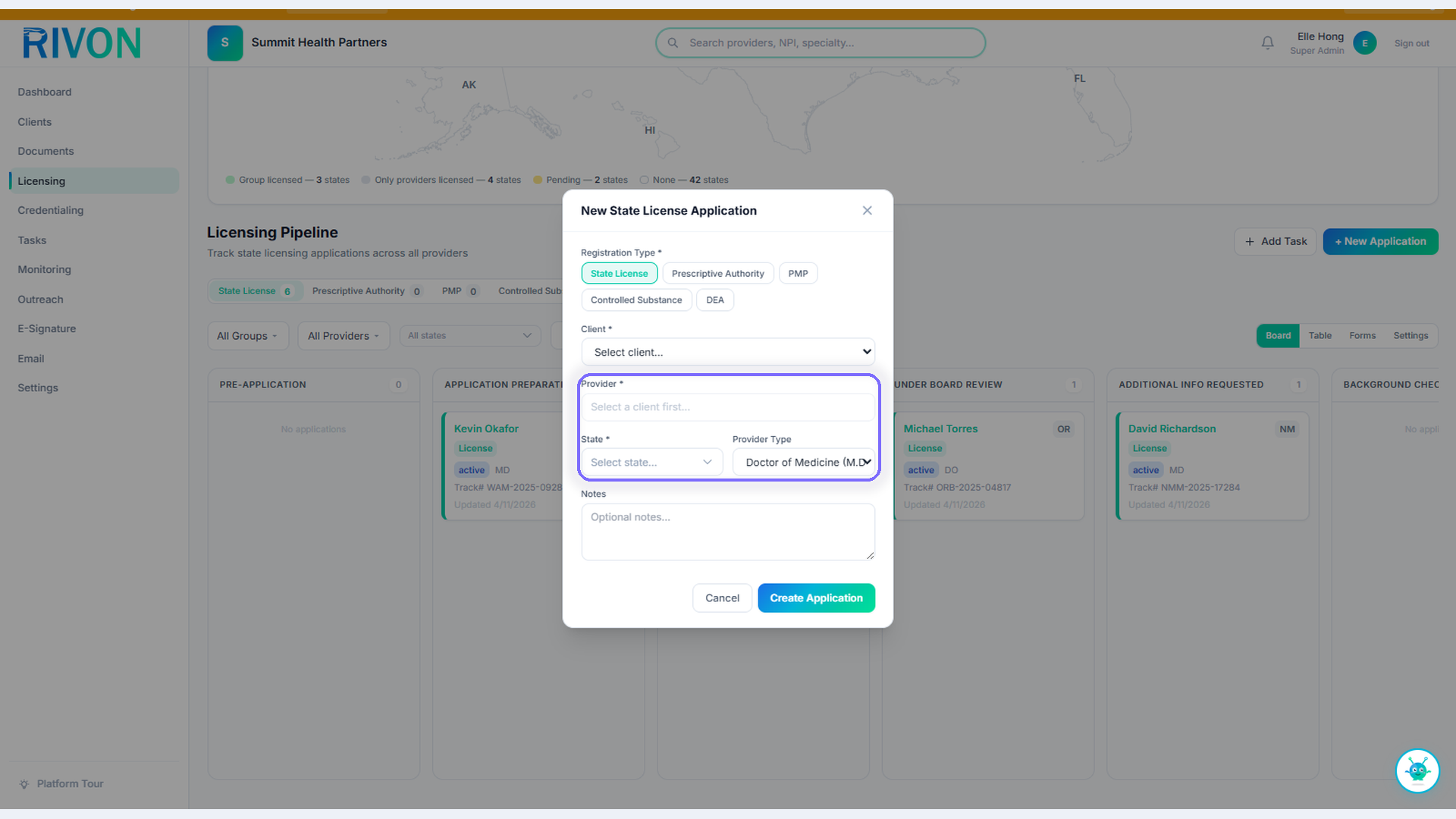
When VitalCare expands into a new state, the application goes on the licensing pipeline board: pre-application, preparation, under board review, additional information requested, background check, and so on. They have tracked 32 applications this way. Anyone on the team can open the board and see which ones are waiting on the board, which are waiting on the provider, and which need a document.
What changed
- One source of truth for 1,339 licenses instead of a spreadsheet only one person really trusted
- Reminders that reach both the team and the provider before a license lapses
- A clear answer to "can we take a patient or a contract in this state?" for both the group and named providers
- Monthly exclusion screening running in the background (more than 3,400 screenings to date)
- 4,800+ provider documents filed where the next person can find them
None of this replaces the people doing the work. Rivon doesn't renew a license on its own, and the boards still set their own timelines. What it does is make sure the right person knows, early, and has what they need in one place.
VitalCare runs payer enrollment in Rivon too. Read how they track roughly 10,000 provider-payer enrollments:
VitalCare credentialing case studyComparing renewal rules across states? Our free tables list cycle, deadline, fee and CE for every state:
License renewal requirements by stateFAQ
Frequently asked questions
- How does VitalCare Health track licenses across so many states?
- All 1,339 of VitalCare's state licenses sit in Rivon against the provider who holds them. A licensing map shows coverage by state, a daily sweep flags anything expiring, and new applications move through a pipeline board.
- What did VitalCare use before Rivon?
- They worked with third-party credentialers, then used MedTrainer, then moved to spreadsheets. MedTrainer was more than they wanted to spend for how little of the work it automated, and the spreadsheets had no automation or reminders at all.
- Does Rivon remind providers when their license is about to expire?
- Yes. Rivon flags upcoming expirations for licenses, DEA and state controlled-substance registrations, and can send the provider a reminder with a secure link to upload the renewed document.
- Can Rivon show which states a group is licensed in versus only its providers?
- Yes. The licensing map colors states where the group entity holds a license differently from states where only individual providers are licensed, and clicking a state lists every provider there with license, DEA and controlled-substance status.