
VitalCare Health: Tracking 10,000 Payer Enrollments Without a Spreadsheet
Key takeaways
- VitalCare Health manages about 10,000 provider-payer enrollment records for 155 providers in Rivon, with nearly 2,000 credentialed so far.
- They had used third-party credentialers, then MedTrainer (costly for the little it automated), then spreadsheets with no automation or reminders.
- Each enrollment is one row per provider per payer, with an assigned specialist and a stage checklist that moves the status forward.
- Payer outcomes that spreadsheets usually lose, like closed panels and not-in-network decisions, are recorded as statuses so nobody re-applies blind.
- Forms are auto-filled from the provider profile and signed electronically, so specialists spend their time on follow-up instead of retyping.
Licensing gets a provider allowed to practice. Payer enrollment gets them paid. For a group like VitalCare Health, with 155 providers each needing to be in network with many payers across many states, the second job is far bigger than the first.
VitalCare now tracks about 10,000 provider-payer enrollment records in Rivon. Nearly 2,000 are credentialed, more than 800 group reassignments are approved, and every other row says exactly where it stands. Here's how they got there.
Outside credentialers, then MedTrainer, then spreadsheets
VitalCare started with third-party credentialers. Outsourcing took work off the team's plate, but it also took the information. Status lived in someone else's system and arrived in someone else's update email.
They moved to MedTrainer to bring the work in house. In their experience the price was high for how little it automated. Specialists were still assembling packets and chasing payers by hand.
Then spreadsheets. One tab per payer, one row per provider, color codes that meant something to whoever made them. A spreadsheet can't send a follow-up, can't tell a provider their CAQH attestation is due, and can't tell you an application has sat at "submitted" for 70 days. At VitalCare's size, that silence is where revenue leaks out.
One row per provider, per payer
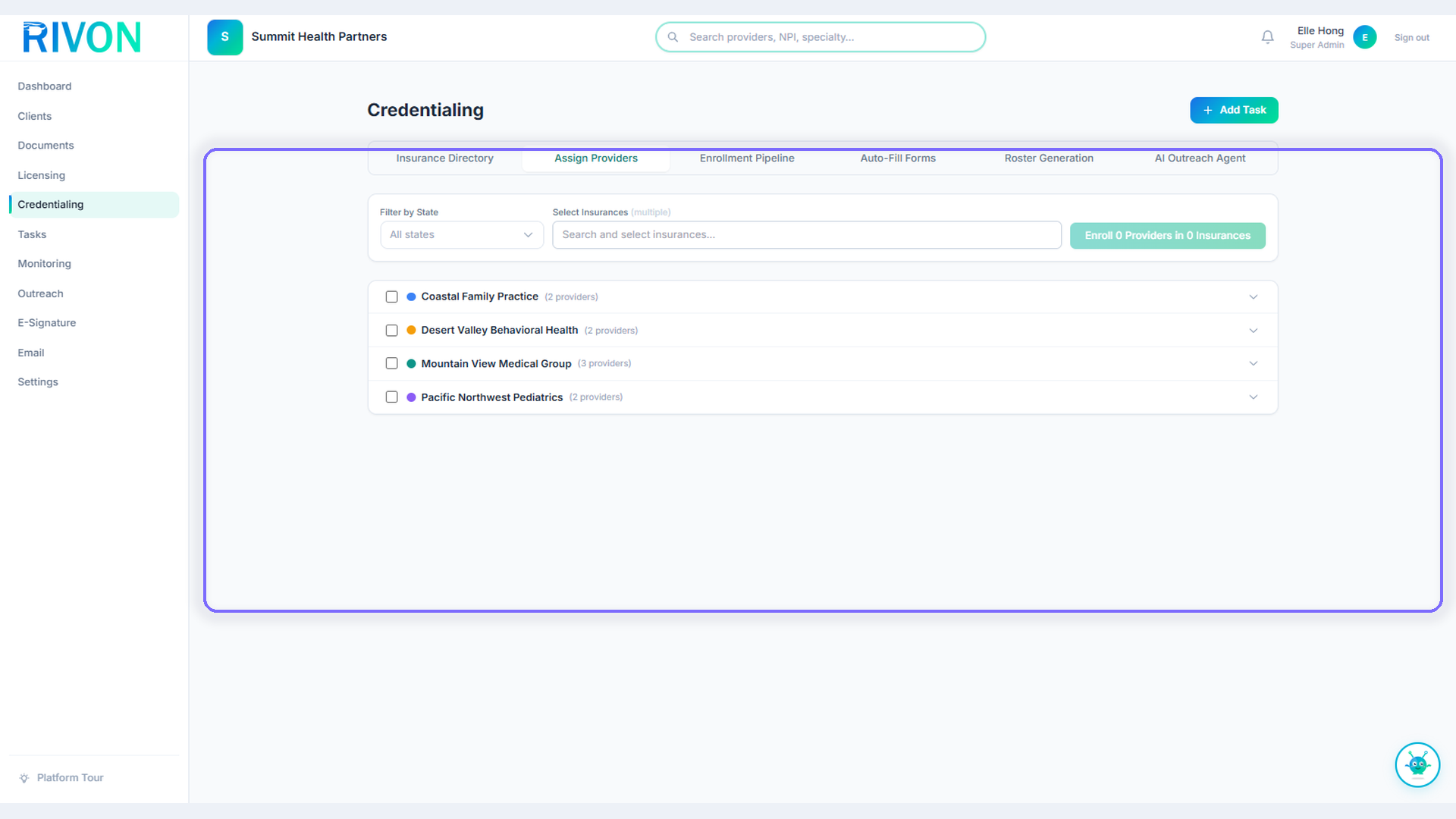
In Rivon every enrollment is its own record: one provider, one payer, one status. VitalCare's pipeline has nine stages, from requested enrollment through application submitted to approval and the renewal stage that brings it back around for recredentialing. Ticking a stage moves the status forward, so the dashboard, the follow-up queues and the turnaround reports all read the same truth.
Every enrollment has an assigned specialist. That one rule, which a spreadsheet can't enforce, ended the "I thought you had it" problem. The credentialing lead reviews a Needs Attention queue weekly instead of scrolling for stale rows.
Outcomes that don't get lost
The statuses spreadsheets tend to drop matter most when you look back. VitalCare records panel closed (225 so far), not in network (318) and denied (12) as statuses on the enrollment itself. When someone asks why a provider isn't with a payer, the answer and the date are right there, and nobody re-applies to a closed panel without knowing it was closed last quarter.
Less retyping, more follow-up
Payer forms are auto-filled from the provider's profile, and signatures go out through Rivon's built-in e-signature (171 documents sent so far). The provider documents payers ask for, more than 4,800 of them, are filed on each provider, so a specialist attaching a malpractice face sheet or board certificate isn't digging through email.
Monitoring that keeps providers on the panel
Getting credentialed is half the job; staying credentialed is the other half. Rivon screens VitalCare's roster against the federal exclusion lists every month (more than 3,400 screenings to date) and sweeps licenses, DEA and controlled-substance registrations daily. A lapsed license or an exclusion hit is a payer-notification problem, and VitalCare hears about it from Rivon first.
What changed
- About 10,000 enrollments in one pipeline instead of a stack of payer tabs
- A named owner on every enrollment and a weekly queue of the ones that need attention
- Closed panels, not-in-network decisions and denials recorded, with dates
- Forms filled from the profile and signed electronically instead of retyped and scanned
- Monthly exclusion screening and daily expiration checks running without anyone remembering to run them
Payers still take as long as payers take. What changed is that VitalCare always knows which applications are waiting on a payer, which are waiting on a provider, and which are waiting on them.
VitalCare also tracks 1,339 state licenses across 53 jurisdictions in Rivon:
VitalCare licensing case studySee how Rivon handles enrollment, from the insurance directory to auto-filled forms:
Payer enrollment softwareFAQ
Frequently asked questions
- How many payer enrollments does VitalCare Health track in Rivon?
- About 10,000 provider-payer enrollment records for 155 providers. Nearly 2,000 are credentialed, more than 800 group reassignments are approved, and the rest are in progress, planned, or closed out with a recorded reason.
- Why did VitalCare move off spreadsheets for credentialing?
- The spreadsheets had no automation and sent no reminders, to the team or to providers. With dozens of payers per provider, applications stalled quietly and follow-ups depended on memory.
- Why did VitalCare leave MedTrainer?
- In VitalCare's experience it cost more than they wanted to spend for how little of the credentialing work it automated, so most of the chasing was still manual.
- Can Rivon track closed panels and not-in-network decisions?
- Yes. Each provider-payer enrollment has a status, including panel closed, not in network and denied, so the outcome and the reason stay on record and the team doesn't re-apply without knowing what happened last time.